

Kicking Off a New Era: Outlook® Leadership Conference Scores Big at Lambeau Field
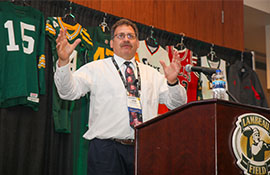
In the heart of “Titletown,” where legendary plays and championship dreams come to life, Advanced Textiles Association® (ATA) hosted its Outlook Leadership Conference June 2–4 at iconic Lambeau Field—home of the Green Bay Packers.
Much like a well-executed game plan, Outlook has evolved into a high-impact leadership event, focused on innovation, strategy and forward-thinking play calls for the textile industry. This year’s huddle brought together top executives and emerging talent.
From keynote addresses to real-time trend analysis, attendees gained valuable yardage by networking, exchanging insights and sharpening their leadership edge. And just as every great team prepares its rookies for the spotlight, companies were encouraged to bring their next generation leaders—positioning them into the future.
First-time attendee Hunter Wells, territory sales manager at Snyder Manufacturing, Canton, Ohio, said the conference was “quite the success. I am very fortunate to be able to represent Snyder Manufacturing, a U.S. manufacture of textiles, along with other companies that can relate with the Berry Amendment and military applications. The existing relationships and new relationships that were bonded is what makes this industry and this conference so important. We are very fortunate to have the people that we do and the mindset that we all have towards the textile industry. It is a group of people that is always looking out for each other, competitors or not, with the similar goal of satisfying customer needs. I will be in attendance next year, and many more to come!”
Added Tom Auer, president of Chicago-based Bearse USA: “In uncertain times, it’s important to re-connect with industry colleagues to see how they’re reacting to market conditions. Outlook provides that forum. The conference had a nice blend of speakers from both inside and outside our industry, which allows you to hear fresh ideas and challenge standard industry groupthink. The world is always changing, and we need to stay current and innovative.”
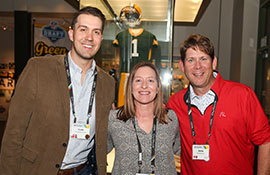
In addition to two networking hours, the event also included an optional golf outing at the Irish Course at Pete Dye-designed Whistling Straits, a tour of Lambeau Field tour and a dinner at the Packers’ Hall of Fame.
Military Morning
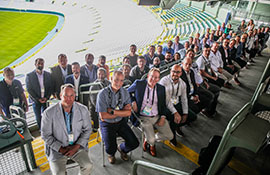
The spirit of service took center stage during Military Morning, a powerful segment dedicated to honoring and harnessing the strength of the military community within the textile industry. The session also included a segment on military textiles supplies procurement.
Steve Janke, founder of Semper Forward, delivered a compelling presentation highlighting the challenges and opportunities in transitioning military personnel to civilian careers. He emphasized the importance of understanding military families’ unique needs during career transitions. He shared that approximately 160,000 to 200,000 service members leave the military annually, with 60% being married and averaging 3.1 children per family.
Janke stressed that companies should view hiring military personnel as more than a transactional process. Instead, he advocated for a relationship-driven approach that supports not just the service member, but their entire family. He highlighted best practices for organizations, including creating veteran employee resource groups, providing clear communication and offering career trajectory opportunities that mirror military advancement structures.
Later, Leighann Mazoki, director of Supplier Operations at the Defense Logistics Agency (DLA), Clothing & Textiles, delivered a comprehensive virtual presentation highlighting current challenges and strategic plans for fiscal year 2025.
She emphasized focus on strategic contracting, particularly for physical fitness items and undergarments not on the procurement list. Key challenges included supply chain disruptions, material availability issues and on-time delivery challenges. Mazoki stressed the importance of transparency from contractors, urging them to communicate potential bottlenecks early in the process. Upcoming procurements include various military uniform and footwear contracts. Despite facing hiring freezes, the division has added approximately 50 new contracting professionals in the past year to support its mission.
The morning wrapped with a compelling panel of veteran leaders who shared how battlefield tactics translate into business success—and why the mission to serve the warfighter continues long after active duty ends.
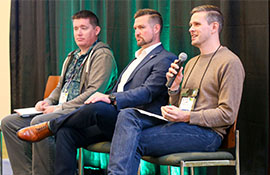
The panel, moderated by Glenn Aust, president of Ehmke Manufacturing Co. Inc., featured Joseph Lorelli of PhnxBmb, Kurt Schimmel, director of Operations at Autometrix; and Zane Vogel, president and CEO of Spiritus Systems. Key themes emerged around accountability, team building and mission-focused management.
Speakers highlighted critical leadership principles such as “mission first, people always” and the value of supporting frontline workers – what one panelist called the organization’s “infantry.” They stressed the importance of setting high standards, delegating effectively and creating a culture of mutual support.
Leadership Development
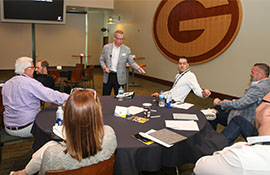
Running concurrent to the military session was a leadership development workshop presented by Steve Baue, executive coach, award-winning CEO and entrepreneur. He explained and demonstrated the four essential management tools that build the foundation for good leadership, regardless of industry, job or employee.
In the afternoon, Baue joined the full group to present an energizing, audience-driven keynote, based on his upcoming book, “The Sh*t They Don’t Teach You: Confessions of an Accidental Leader,” which covers a simple system to capture some of the most important components of leadership. He shared a five-step leadership development process, emphasizing the importance of personal growth and learning from everyday experiences. Baue stressed that most leaders are not trained before taking leadership roles, urging participants to take responsibility for their own development.
USINFI and Washington Policy Update
Following was a report on the U.S. Industrial and Narrow Fabrics (USINFI) and an update on trade and legislation at the federal level along with a recap of the importance of USINFI and its annual Advocacy Day on Capitol Hill.
Auggie Tantillo, president of SRG and Associates, provided a comprehensive overview of current trade policy challenges. He discussed the Trump administration’s new tariff strategies, focusing on addressing the U.S. trade deficit and potential reforms to de minimis shipping regulations that significantly impact the textile industry. He also discussed the growing controversy over PFAS, better known as “forever chemicals.”
Made in Wisconsin, Made in America
Peter Derleth, CEO of Ripon Athletic, took the stage to share how his company continues to raise the bar in American-made performance apparel. Dating back over 100 years, Ripon Athletic employs 150 people in rural Wisconsin and manufactures high-performance jackets, uniforms and custom team gear worn across the spectrum, from high school to pro sports – including the Green Bay Packers.
Derleth highlighted the company’s innovation, such as sublimation technology and compression jerseys, and their sustainability efforts, including recycling materials. He also discussed the importance of customer service, relationships and maintaining a family-like company culture.
Tantillo closed out the day with an interactive, educational session on the most current developments in trade under the Trump Administration. The presentation highlighted the administration’s use of the International Economic Emergency Powers Act (IEEPA) to impose tariffs on multiple countries, with goals ranging from addressing trade deficits to combating the fentanyl crisis and immigration challenges.
Tech, AI and Economic Trends
On Day 2, Craig Dickman, managing partner of TitletownTech, shared how the firm brings a practitioner’s mindset to venture capital, focusing on applied innovation and real-world problem solving. Backed by Microsoft and the Green Bay Packers, TitletownTech invests in startups that move fast and think practically. Dickman said that we’re entering an “age of acceleration,” where technology is changing not just yearly, but sometimes daily.
Elaine Stephens, head of Customer Engineering, Wisconsin at Google, presented “How Companies Are Driving Value With AI” during a technology session. She offered insights into how artificial intelligence is reshaping business innovation.
Stephens provided practical examples of AI’s potential across various industries. From hyper-personalized marketing campaigns to streamlined customer service and product development. “We need AI that unlocks enterprise expertise,” Stephens said. She also explained how AI can assist textile producers in such areas as AI-power design software for personalized fabrics, automated inspection systems for textile defects, predictive maintenance for textile machinery, supply chain optimization with AI-driven logistics and RFP responses.
“The future is collaborative,” she added. “AI is kind of like my personal co-worker. The companies that will lead tomorrow are the ones that are not just adopting AI, but are integrating it into the core of their business to unlock new levels of productivity and creativity.”
Rounding out the program was Matt Muenster, chief economist at Breakthrough, provided a nuanced view of the current U.S. economic landscape, emphasizing both challenges and opportunities across various sectors. The presentation revealed a mixed economic picture, with consumer sentiment at recessionary levels, yet key indicators showing resilience.
The economist noted a relatively low 25% chance of recession, citing strong underlying economic indicators. Energy prices have decreased, potentially providing some relief to businesses and consumers. Key takeaways include the need for businesses to develop personalized economic dashboards, stay informed about industry-specific trends and remain adaptable in a complex economic environment.
“The focus on leadership was both relevant and thought-provoking, but what I value most was the time spent with both new and longtime friends across the textile and manufacturing industry,” said Robert Hinsch, Los Angeles-based vice president of Business Development at TVF. “It was a great opportunity to reconnect, share insights and strengthen relationships that continue to shape our work.”